Student Spotlight: Barclay Briggs '24


Student Spotlight:

Your gift supports students like Barclay


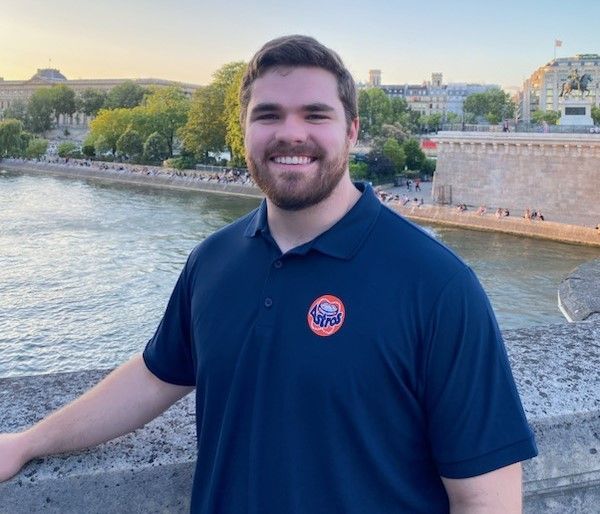
You can usually spot Barclay Briggs ‘24, somewhere outside. Whether it’s on the gridiron with his fellow Davidson College football teammates, or on the water hauling in his next big catch, Barclay is a true outdoorsman. This fall however, Barclay has found himself indoors leading a new student group dedicated to ideological diversity and a lively, and fearless freedom of debate and deliberation: the Davidson Free Speech Alliance.

Hailing from Houston, Texas, Barclay’s love for nature mirrors his commitment to the open exchange of ideas, where different perspectives can flourish just like the diverse landscapes he enjoys. Over the course of his Davidson career, Barclay has felt strongly about improving the state of intellectual diversity, and civil discourse on campus. He explained that these feelings compelled him to launch DFSA this year: “It is a terrible feeling to sit in a class and not feel comfortable voicing an opinion that may be controversial, and that can’t be the standard. The standard must be free inquiry, free expression, and free discourse.” Barclay quickly discovered that he was far from alone on campus, as almost overnight, the DFSA ranks swelled to over fifty members.


Barclay and the DFSA have partnered with the Davidsonians for Freedom of Thought and Discourse to launch a variety of programs this year, aimed at enhancing and supporting a positive free speech culture on Davidson’s campus. “DFTD supports me and DFSA by providing resources, funding, knowledge, and experience in free-speech advocacy. Without them, DFSA leadership would have a very tough time bringing qualified speakers to campus, and we would severely lack the funding to put on the events we have planned. I am thankful for DFTD’s guidance, and I look forward to their continued support of free speech on Davidson’s campus,” Barclay explains.


As Barclay approaches his post-Davidson plans, he will return to Texas to work for a petrochemical trading and marketing firm. But his dedication to free speech and ideological diversity will continue to inspire positive change on his college campus and beyond.


Join Barclay Briggs in supporting the cause of free speech and ideological diversity. Your gift helps to fund essential programs, speakers, and resources that make a difference in the lives of students like Barclay and ensure that every voice is heard.


Make a Gift to DFTD


June 29, 2026
As America commemorates 250 years of independence, we reflect on the enduring principles of liberty and learning that have defined Davidson College for nearly two centuries.
June 21, 2026
By Todd Zywicki The Wall Street Journal June 21, 2026 Auburn University is known for its agricultural and STEM programs, its flight school and athletic programs. But the land-grant university recently became notable for another reason: The board of trustees is taking control of the school back from its faculty. The board began seizing the university’s academic programs—including curriculum, course offerings, degree requirements and academic credentials—at its June 5 meeting. The board also dissolved the faculty senate and replaced it with an advisory council to the president, which includes two faculty members from each of the university’s colleges and additional members appointed by the president. The board’s assertion of authority mirrors incoming mandates by the Alabama Legislature restricting the role of faculty senates in the state’s public university system. Predictably, Auburn’s faculty has responded with howls of outrage, decrying these intrusions on the faculty’s authority over academic operations. How could outsiders appointed through a political process have the expertise to make such delicate decisions? I’ve been a professor at a state university for almost 30 years, and I am sympathetic up to a point. But before becoming a professor I was a bankruptcy lawyer. And bankruptcy law teaches an important lesson for how academia can respond to this moment. Bankruptcy gives businesses an opportunity to admit mistakes, reform and emerge stronger. Successful enterprises don’t need bankruptcy lawyers. But when an enterprise loses its way, it goes into receivership. Most universities aren’t financially bankrupt but have lost their mission and direction. Society has long recognized certain institutions’ authority to manage their own affairs. Two notable examples are licensed professionals—such as doctors and lawyers—and universities. Universities, even state universities, have run their enterprises with minimal external oversight. Faculties enjoyed substantial rights of self-governance because they committed to higher standards than those required by ordinary jobs. Professors would establish and maintain standards of scholarly integrity, freedom of speech and inquiry, and rigorous dedication to merit-based assessment of research in specialized areas. They policed their own house, enforcing norms of truth-seeking, maintaining scholarly integrity and rigor, and ensuring that students emerged with basic knowledge, employable skills and civic competency. But over the past several decades, commitment to those values collapsed. Surveys by the Foundation for Individual Rights and Expression consistently reveal fear among students and faculty around expressing unfashionable ideas. Universities have seen shout-downs, cancellations and even violence against speakers. Merit and quality yielded to “diversity” and “equity.” Truth-seeking has been displaced by faddish theories and ideologically charged teaching and research. Professors design esoteric departments and teach niche classes to cliques of activist students while the needs of other students and taxpayers for real education go unaddressed. Like companies I represented, universities have lost their way. And many have proved either unable or unwilling to self-correct. When that happens, it is appropriate to put institutions into receivership until they reform and rededicate themselves to their mission. At Auburn incoming students must now take certain required civics and history courses to master basic competency in U.S. history and government. To ensure the classes actually meet that objective, professors will have to make their syllabi publicly available. In the classroom, instructors will be expected to stick to the matter at hand and avoid free-ranging political punditry. Just as other companies can learn from the ones that go bankrupt, other institutions of higher education can learn something from Auburn: Fix what’s broken, or someone else might fix it for you. Mr. Zywicki is a professor at George Mason University’s Antonin Scalia Law School. He was a Dartmouth College trustee, 2005-09. https://www.wsj.com/opinion/bankruptcy-and-higher-education-4c2b178e
June 19, 2026
By the Editorial Board The Wall Street Journal June 19, 2026 The Supreme Court’s 2023 ruling against racial preferences is turning out to be a landmark with profound consequences as its influence spreads. On Thursday the famously progressive Wisconsin Supreme Court ruled unanimously that a state program that issued scholarships based on race violates the U.S. Constitution. Justice Annette Ziegler wrote for the court that the Constitution requires “that every person ‘must be treated based on his or her experiences as an individual—not on the basis of race,’” and that the state cannot “use race as a factor in affording educational opportunities among its citizens.” That must have been painful for the activist liberal majority on the court. In a concurrence, Wisconsin Chief Justice Jill Karofsky took some shots at Students for Fair Admissions v. Harvard College (2023) before acknowledging that “I am bound by the precedent set forth in SFFA” and other Supreme Court rulings “when interpreting the Fourteenth Amendment.” The case was brought by the Wisconsin Institute for Law and Liberty against a 1985 Badger State law that reserved need-based scholarships through a grant program for “Black American,” “American Indian,” “Hispanic” and some Southeast Asian undergraduate students enrolled in Wisconsin’s private and technical colleges. Last week the Iowa Supreme Court ruled that a scholarship program earmarked for black University of Iowa students studying physical sciences was “impracticable” under SFFA. State governments would be wise to repeal these discriminatory grant programs, or the courts will do it for them.
Show More